

School Choice Is Expanding. Will Independent Schools Participate?
School choice continues to make progress across the United States. The latest growth in choice comes from universal school choice programs, publicly funded private school scholarship programs with universal eligibility. To date, 18 states have legislated or launched some form of a universal education savings account (ESA) program. In addition to state-run programs, 31 states have opted into the national Education Freedom Tax Credit program, which offers dollar-for-dollar tax credits for donations to scholarship-granting organizations.
The success of school choice programs depends on both supply and demand. These programs help fund the demand for choice signaled by parents. But education service providers must provide the supply and be willing to take the scholarship dollars.
Legislatures have built the programs. Will the schools come?
Research shows that private school leaders have real concerns about what participating in such programs might mean for their school’s future. If we begin accepting public dollars, will we invite greater government scrutiny? Will the state attach additional regulations to these programs in the future? What will happen to scholarship families if the funds go away?
Those questions may be particularly relevant for independent schools. Independence is not just a label. Self-governance, self-support, control over curriculum, admissions, and faculty are among the defining characteristics of independent schools. Here is a fairly simple working definition: an independent school mostly funds itself and is substantially free from external or government control.
In other words, the very thing that makes an independent school independent is part of what makes the decision to participate in a publicly funded choice program complicated.
Main Findings
A new article published in the Journal of School Choice with Matthew Lee, Ben Scafidi, Roger Tutterow, and Damian Kavanagh focuses on this supply-side question: When relevant choice programs are available, which types of private schools choose to participate? And when a program launches, how quickly do those schools come?
We surveyed 473 private school leaders across 31 of the 36 states with private school choice programs. These leaders represented member schools of MISBO, the Association of Christian Schools International, and other organizations, both secular and religious.
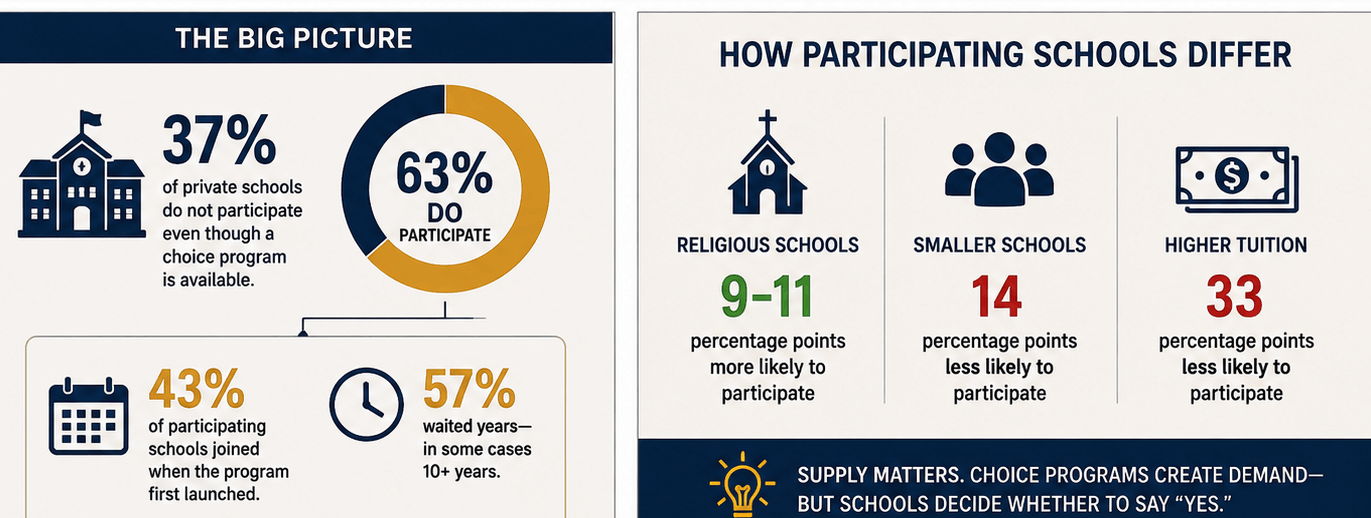
The first finding is pretty striking: 37 percent of schools do not participate even though a choice program is available to them. Among the 63 percent that do participate, only 43 percent reported participating when the program first launched. Many schools waited years, in some cases 10 years or more, before participating.
How are the schools that participate different from the ones that don't?
Religious schools are 9 to 11 percentage points more likely to participate than nonreligious schools. Schools with enrollment below 250 students are 14 points less likely to participate. Tuition also matters: schools charging more than $20,000 are 33 points less likely to participate.
That last finding should get the attention of independent school leaders. While our study looked at the broader private school universe, the average tuition in our sample was $21,014, and higher-tuition schools were substantially less likely to participate.
Reflections for Independent Schools
For independent schools, I think the most interesting part of this research may be what it doesn't tell us.
We know that higher-tuition schools are less likely to participate. We know smaller schools are less likely to participate. And we know that a significant number of schools take a wait-and-see approach rather than joining a program when it launches.
What we don't yet know is exactly why independent schools make those decisions.
There are some logical possibilities. The scholarship amount may be relatively small compared with tuition. Smaller schools may not have the administrative capacity to manage another program. And, perhaps most importantly, independent schools may be weighing increased access for families against potential long-term consequences for institutional autonomy.
The academic article points directly to that tension. Higher-tuition schools may perceive greater reputational or regulatory risk from participation, and accepting public financial assistance can raise questions about future compliance obligations. Smaller schools may face a different problem altogether: limited staff capacity to evaluate, implement, and administer these programs.
That makes the wait-and-see finding particularly interesting. Not participating at launch does not necessarily mean "no." For many schools, it appears to mean "not yet."
For independent school leaders and boards, that may be the most useful takeaway. The question is not simply whether school choice is good or bad, or even whether your school should participate. The better questions are: What would participation mean for our mission? What obligations come with the funding? What happens if those obligations change? And how much independence are we willing to trade, if any, in exchange for making our school accessible to more families?
Those are questions every independent school will ultimately have to answer for itself.