

Trustee Types and Weird Board Members
I was working with a board recently and a trustee spent part of the meeting explaining artificial intelligence to the room. He had done his homework. He referenced the End of Reading is Here article in The Atlantic, something from The Chronicle of Higher Education, and several other examples I can’t recall (probably Harvard Business Review because everyone references HBR). He clearly knew more than most of the people in the room.
As he talked, I found myself less interested in whether his observations about AI were correct than in what role he believed he was playing. Was he helping the board think? Was he bringing outside expertise? Was he warning the school about something? Was he auditioning for a larger role in the conversation? Or maybe some combination of all four.
Nothing unusual to see here. No one stormed out. No one disagreed. The head didn’t dive under the table. And there really wasn’t much of a conversation. But the moment captured something you’ve probably witnessed in boardrooms: perfectly reasonable people can get a little weird when they join boards.
I do not mean weird in the diagnostic sense; "trustee-splaining" is going to happen no matter where you are and sometimes you just have to bless your heart through it (for my northern friends, the closest translation of bless your heart is "good for you" and for my west coasters, think "love that for you"). Board service changes the context. People who are measured and sensible in the rest of their lives can become unusually anxious about risk, unusually attached to a point of view, unusually interested in access, or unusually eager to demonstrate expertise. The boardroom gives those instincts a place to reveal themselves.
That is worth understanding because existing governance training generally tells us a great deal about what a board should do, but tells us much less about why the people around the table behave the way they do while trying to do it.
The goal isn't to get better trustees. It's to get better at leading the trustees you've got.
We Have Plenty of Governance Frameworks
Independent schools are not short on guidance. The NAIS Principles of Good Practice and various accreditation standards describe the expected behavior of boards and trustees: hold the mission in trust, govern rather than manage, support and evaluate the head, maintain confidentiality, and act for the institution rather than a constituency. Useful and familiar stuff.
The SAIS Governance Health Index moves beyond expectations and asks how governance is actually functioning. Its emphasis on competencies, maturity, and adaptive thinking is helpful because a board can know the rules and still not be very good at governing under pressure.
Other frameworks look at different layers. MISBO and ExploElevate’s DEFCON model looks at institutional health across enrollment, net tuition revenue, finances, mission delivery, faculty, facilities, leadership alignment, data quality, and parent trust. ASAE's ForesightWorks looks outward at forces that may reshape an organization before they arrive in the strategic plan with their shoes already on the furniture.
I think of these frameworks as operating in different lanes on the same highway. NAIS and accreditation ask what good governance should look like. The SAIS index asks how the board is functioning. DEFCON asks how the institution is doing. Foresight asks what is happening outside the institution that may matter next.
All useful. None quite explains the trustee with the AI articles. For that, I wanted another lens.
Five Ways Trustees Try to Be Useful
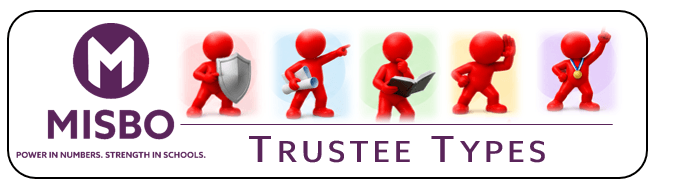
The five trustee types grew out of a simple question: what is this person trying to get done through board service? Not what is wrong with them, although that might be a pertinent question. Not which personality test bucket they belong in, although sorting people into categories and watching them act against type is the premise of so many good episodes of train wreck TV. Just this simple question: what are they trying to accomplish here? I think of the Jobs To Be Done from NAIS which was predicated on Clayton Christensen’s work on disruptive innovation and asks the question – what job are you hiring this thing or person to do. In this case, the script is flipped and the question becomes what job does this person think they were hired to do?
The five trustee types described below are heuristics, not validated personality types. No one should put them on a scorecard, and most trustees will show more than one type. They are useful patterns for recognizing and interpreting trustee behavior.
 THE PROTECTOR
The Protector is watching for risk. Surprises, ambiguity, and loss of control get their attention quickly. At their best, they notice the pothole before the rest of the board drives into it. At their worst, every pothole becomes a sinkhole. The Protector can borrow your nervous system if you let them.
THE ARCHITECT
The Architect wants to shape what comes next. They like to be involved early, before the cake is baked and the board is asked whether they like the frosting. They are often excellent at framing possibilities. They are also the trustee voted most likely to wander from strategy into redesigning someone else's work.
THE INTERPRETER
The Interpreter listens for meaning. Rename a program, change the calendar, revise a tradition, and they will usually ask what the change says about the school. They have a gift for making the practical symbolic, which can keep a board connected to mission and meaning, and can turn an ordinary decision into a seminar on who we are as a people.
THE INSIDER
The Insider values access, relationships, and being in the know. They often carry the school’s institutional memory. Student handbooks are a good example. The more bizarre and arcane the rule, the better the odds that something once happened to make somebody write it down. The Insider usually knows that story. If they are also an alum, there is at least a nonzero chance they were involved.
THE CREDENTIAL-SEEKER
The Credential-Seeker wants to contribute and to be seen contributing. Board service may matter to their professional identity as well as to the school. They often come prepared, bring outside expertise, and work hard. Under pressure, contribution can become performance. This is where three articles about AI can occasionally turn into a visiting professorship.
None of these is a bad trustee or a villain. In fact, a board with none of these instincts would be pretty useless. The interesting part is what happens when one instinct gets too much oxygen, or when the head responds to it badly.
Generative Questions Make the Differences Visible
I have written elsewhere about the three modes of governance described by Chait, Ryan, and Taylor: fiduciary, strategic, and generative. Fiduciary work is oversight, stewardship, and accountability. Strategic work is about priorities, planning, and positioning. Generative work happens constantly and is the board trying to make sense of something before deciding what, if anything, to do about it.
That distinction matters. Boards are pretty good at discussing things once they have become proposals, budgets, policies, or plans. Generative conversation creates room to ask what is changing, what we may be missing, and whether we have even framed the issue correctly.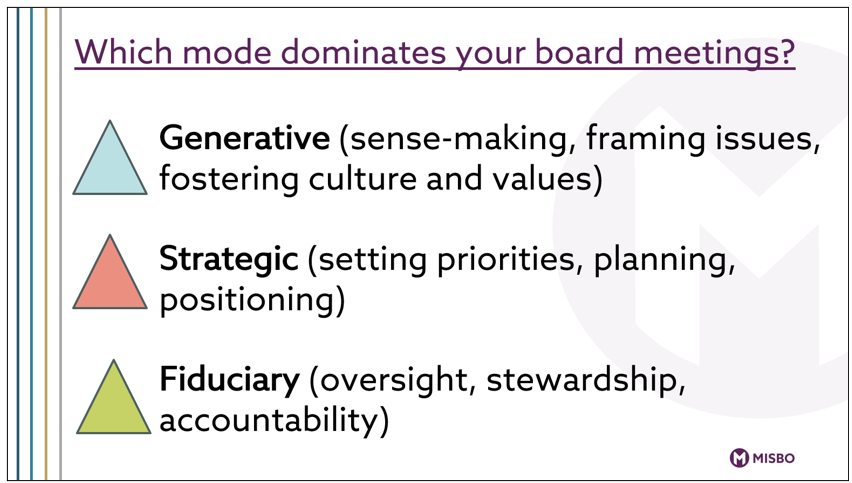
At MISBO, we develop a series of generative questions for the year that follow a progression from disruption to reflection: challenge what we assume, look ahead to what we will need, confront the choices that follow, check whether we are drifting, and reflect on what we have learned. This works for us because it is aligned to our board meeting pattern and flows alongside the arc of the school year. You can read our questions and some of our thoughts here.
Good generative questions do not have obvious answers. That is the point. They surface assumptions, expose differences, and make people show their work.
One of my favorites is the very first one we considered: "What are our sacred cows, and do we need to send some to market?" The question is not actually about cutting programs. It is about discovering what the institution treats as untouchable, and whether those things are still untouchable for a good reason.
As an exercise, we can think through how each of the trustee types hears this question and how they might respond to it. Which trustee type helps the conversation, and which one could hijack it? What does the head need to notice before the discussion drops from sense-making into tactics, defense, or theater?
The Protector hears risk. What are we about to break? The Protector will immediately start looking for consequences, constituencies, and unintended damage. That can be enormously useful because sacred cows often became sacred for a reason. The risk is that every possible consequence starts to sound like a reason not to move. The head's job is not to neutralize the Protector, but to separate legitimate risk from generalized anxiety.
The Architect hears possibility. Excellent, what can we build instead? The Architect is energized by the permission to rethink something that has been treated as fixed. They can help the board imagine alternatives and move beyond incrementalism. The risk is that the question becomes an invitation to redesign the program, process, or structure on the spot. The head needs to keep the Architect in the work of framing possibilities rather than assigning themselves the work of implementation.
The Interpreter hears meaning. Is the cow actually sacred, or is it simply old? The Interpreter wants to know what the practice represents and whether changing it says something important about mission, identity, or values. This can prevent the board from discarding something whose significance is not immediately obvious. It can also make a relatively practical question symbolic very quickly. The head needs to make space for meaning without allowing every decision to become a referendum on who we are as a people.
The Insider hears history. They may know exactly how the cow became sacred, who fought for it, and which former trustee is still emotionally invested in its survival. That context is often invaluable because institutions forget why they do things long before they stop doing them. The risk is that history becomes veto power, or that the Insider begins speaking for constituencies rather than helping the board understand them. The head needs to use the history without becoming trapped by it.
The Credential-Seeker hears comparison. What are sophisticated organizations doing? What have the best boards already stopped doing? The Credential-Seeker can bring useful outside examples, research, and expertise to a conversation that might otherwise become too inward-looking. The risk is that the external example becomes proof of sophistication rather than evidence to consider. The head needs to welcome the expertise while keeping the board focused on whether the idea actually fits this institution.
You can do this activity with the other generative questions in the list or with your own. While the questions are interesting, the reactions are often more interesting.
Heads Get Weird Too
The leadership research that helped me think about this comes from work from two Norwegian economists Øyvind Lund Martinsen and Lars Glasø who were studying work place dynamics and managers vs leaders. I might have gotten swept up in Norway fever this past summer during the World Cup, but who didn’t!?! #VikingRow. Their work was highly correlated with the five-factor model of personality. Emotional stability, openness, extraversion, agreeableness, and conscientiousness are not a magic governance recipe. They are simply a useful reminder that what the head does in response matters as much as what the trustee does first.
A worried Protector can make a head defensive. A persistent Interpreter can make a head impatient. An Insider pushing for access can make a head suddenly formal and distant. A Credential-Seeker who feels dismissed may respond by demonstrating even more expertise. None of these pairings improves with escalation.
This is the piece of the model I find most useful in practice. You do not have to agree with the trustee's instinct. You do have to avoid getting recruited into it.
That is what I mean when I say the Protector can borrow your nervous system. The same is true, in different ways, of all five types. A head who notices the pattern has a much better chance of keeping the conversation where it belongs.
Effective leadership is less about who the leader is and more about how the leader regulates themselves in response to others.
The Five Trustee Types in the Real World
The five trustee types offer a way to notice the human layer underneath the formal one. Why is this trustee asking this question? What are they protecting, building, interpreting, preserving, or proving? And what is my own reaction doing to the conversation?
That matters most in the places where boards are supposed to be useful: volatility, uncertainty, complexity, ambiguity, competing values, and decisions where the answer is not sitting in the packet. There are problems we can solve and problems we can only navigate and understanding the complexities requires a board to have different instincts around the table. Risk. Possibility. Meaning. Relationships. Expertise. The trick is not eliminating those instincts. It is keeping any one of them from taking over the room.
Which brings me back to the self-proclaimed Trustee AI expert. I still don’t know which of the five types best describes that trustee. That is probably a good sign. He may have been acting as an Architect, trying to make sure the school was looking ahead. He may have been a Protector, worried about what AI could do to education. He may have been an Interpreter, asking what all of this means for teaching and learning. And yes, there may have been a little Credential-Seeker in the mix. Most of us contain multitudes.
The useful question for the head was never, "How do I get him to stop talking about AI?" It was closer to, "What is useful in what he is bringing, and how do I keep the conversation at the board level?"
That distinction matters. Expertise should improve the board's questions. It should not quietly expand the decisions a trustee owns.
Perfectly reasonable people do get a little weird when they join boards. So do perfectly reasonable heads when the board gets under their skin. I think good governance is partly the art of noticing both before the weirdness becomes contagious.
Frameworks referenced
 |
 |
 |
 |